

How Islo ships to bare metal and customer clouds
Islo's compute plane runs on its own bare metal, in customers' AWS accounts, and in customers' data centers. With Alien, every release reaches all of them in about a minute, without Ansible, SSH, or VPN.
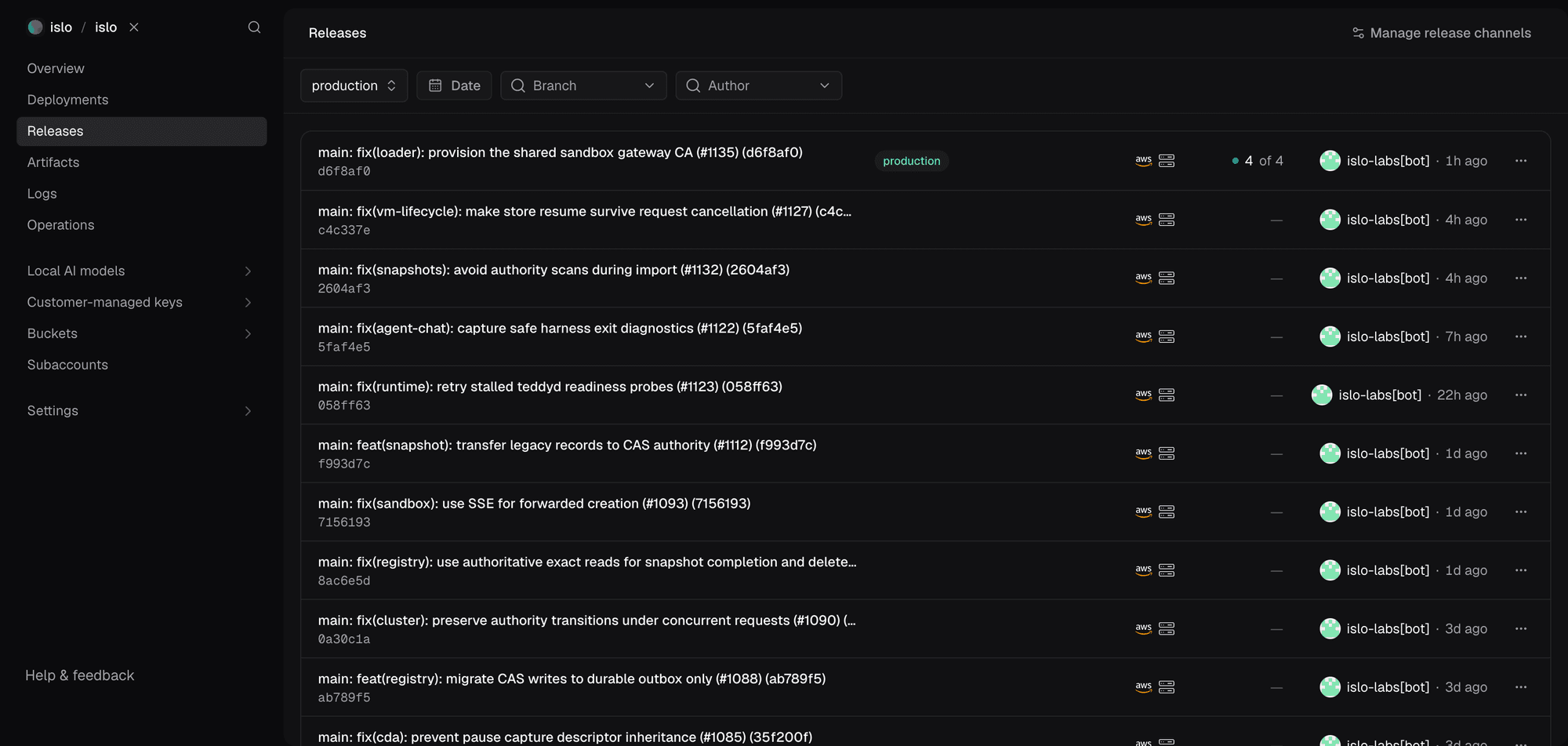
- to roll a release out to production
8 minto1.2 min- production servers since moving to Alien
8to23- from first design to a live production region
- 5 weeks
Islo is a safe software factory platform. It lets its customers automate real engineering work with agents, with deterministic flows and gates. Every agent gets a real computer: a full virtual machine with its own Linux kernel, set up like a developer's machine, with the company's tools and services wired in.
Islo is built in two parts. The control plane, with the dashboard, policies, integrations, and billing, runs in Islo's AWS account. The compute plane is where the agent computers run, and it runs in very different places: on Islo's own bare-metal servers in several regions, in a customer's AWS account, or on servers in a customer's own data center.
Most customers use Islo's regions, which is the fastest way to start. The largest customers need the computers inside their own infrastructure. Their source code falls under policies that keep it on infrastructure they control, and the systems that make an agent useful, like private registries, internal APIs, and staging environments, are often reachable only from inside their network. With Islo BYOC, the compute plane runs there, and Islo still operates it.
Alien runs Islo's compute plane in every one of those places, from one release. Islo's bare metal and its customers' servers get the same workflow as a cloud deployment: a release is running in about a minute, with no Ansible, SSH, or VPN.
Architecture diagram. Islo control plane manages 3 remote environments: Islo regions (Islo's bare metal); Customer 1 (Customer's AWS account); Customer 2 (Customer's on-prem servers).
Our largest customers won't send their source code to another company's cloud. Alien lets us run Islo inside their infrastructure, and they still get every release the day we merge it.
One release, every server
Every merge to main becomes a release, identified by its commit, and goes to a staging channel first. Promoting it to production rolls it out to every production deployment, Islo's own bare-metal regions and its customers' environments alike. That's more than 450 releases since July.
Total releases at the end of each week, from Alien. Each one goes to staging, then to Islo's regions and its customers' environments.
| Week of Jun 29 | 3 |
|---|---|
| Week of Jul 6 | 34 |
| Week of Jul 13 | 50 |
| Week of Jul 20 | 61 |
| Week of Jul 27 | 75 |
| Week of Aug 3 | 83 |
| Week of Aug 10 | 107 |
| Week of Aug 17 | 131 |
| Week of Aug 24 | 162 |
| Week of Aug 31 | 182 |
| Week of Sep 7 | 200 |
| Week of Sep 14 | 224 |
| Week of Sep 21 | 244 |
| Week of Sep 28 | 259 |
| Week of Oct 5 | 296 |
| Week of Oct 12 | 332 |
| Week of Oct 19 | 358 |
| Week of Oct 26 | 389 |
| Week of Nov 2 | 434 |
| Week of Nov 9 | 453 |
A production release reaches a deployment in a median of 1.2 minutes, health checks included. The rolling Ansible release it replaced took about eight.
An upgrade never kills a running computer. Someone's work is inside it. When a new version ships, the new process takes over from the old one in about a second, and the old one keeps serving the computers already on it until they finish. When a server does have to stop, it refuses new work and waits for the computers on it, for up to 24 hours.
Releases can also be held back where it matters. A region can follow its own channel, and a hotfix can go to one customer's servers without them reinstalling or rejoining anything.
Bare metal, on-prem and customer clouds
Islo's workload is a hypervisor, not a web app. It takes over the server: network bridges, firewall rules, root access, and one hypervisor process per agent computer. Alien runs it directly on the host as a privileged daemon, rather than inside a container that would compete with it for the server.
- Bare metal and on-prem. A customer's platform team joins each server with one command and a token. It's the same command on every server, and the token can be revoked from the dashboard. It's closer to adding a device to a VPN than to running a provisioning playbook.
- AWS. The customer launches a CloudFormation stack or applies a Terraform module. The servers are ordinary instance types with nested virtualization, so a new AWS account doesn't start with a support ticket for bare-metal quota.
- Domains and certificates. Every deployment gets its own domain, with a public address for each agent computer beneath it, and Alien creates and renews the TLS certificates. Islo moved its existing regions onto these certificates with zero downtime: 23,000 verified requests during the move, none failed.
- Monitoring. Health, versions, and logs for every deployment are in one place, for Islo's team and the customer's. Deployments connect outbound only, so a customer's endpoints can stay behind their VPN.
- Setup. Alien generates the setup portal and the command-line tool the customer uses,
isloctl, both branded as Islo, from Islo's own deployment definition.
If a server loses its connection to Alien, nothing stops. In a test, a deployment was cut off from Alien entirely and its server rebooted. It came back up and kept creating new agent computers.
Islo's own regions run the same way
Islo used to deploy its bare-metal regions with Ansible: a reasonable fit for servers you own and can count, but not one that extends to servers you don't. You can't hand a customer your inventory file, your VPN keys, and your CI secrets.
So the system Islo built for customers replaced its own deployment process too. Its France region was the first built on Alien, five weeks after the first design. Canada followed, moved from Ansible to Alien with its agent computers kept running throughout. Islo adds servers faster now, too. Under Ansible it went from three production servers in February to eight in June, about one a month, each added with a change to the inventory. Today it runs 23, more than 2,000 CPU cores, and each one gets every release the same way a customer's server does.
We used to babysit Ansible every time we added a server. Now we merge, and a minute later it's live on our bare metal and in our customers' environments.
Agents on the customer's own models
An agent needs a model as much as a computer. Many of Islo's enterprise customers already pay for one: a Databricks or Amazon Bedrock account, with the models their security team approved and AI spend they've already committed. They want their agents to run on it.
Islo connects them with Local AI models. A customer's admin opens Bring your own in Islo's integrations, picks Databricks or AWS, and connects their account through a setup page branded as Islo. Islo never receives their credentials. From then on, Islo's gateway sends that customer's agent requests through Alien to the models in their own account, and the usage counts toward their contract instead of Islo's AI bill.
Islo built it in about three weeks. The first requests went through Alien on August 19, and both Databricks and Amazon Bedrock were live for customers by September 10.
What's next
Islo runs in customers' AWS accounts and in customers' data centers today, with Google Cloud and Azure next. Alien maps the same deployment definition onto both, so adding a cloud is a change of configuration, not a new integration to build and maintain.