
BYOC pricing: charge more, not less
 Alon Gubkin
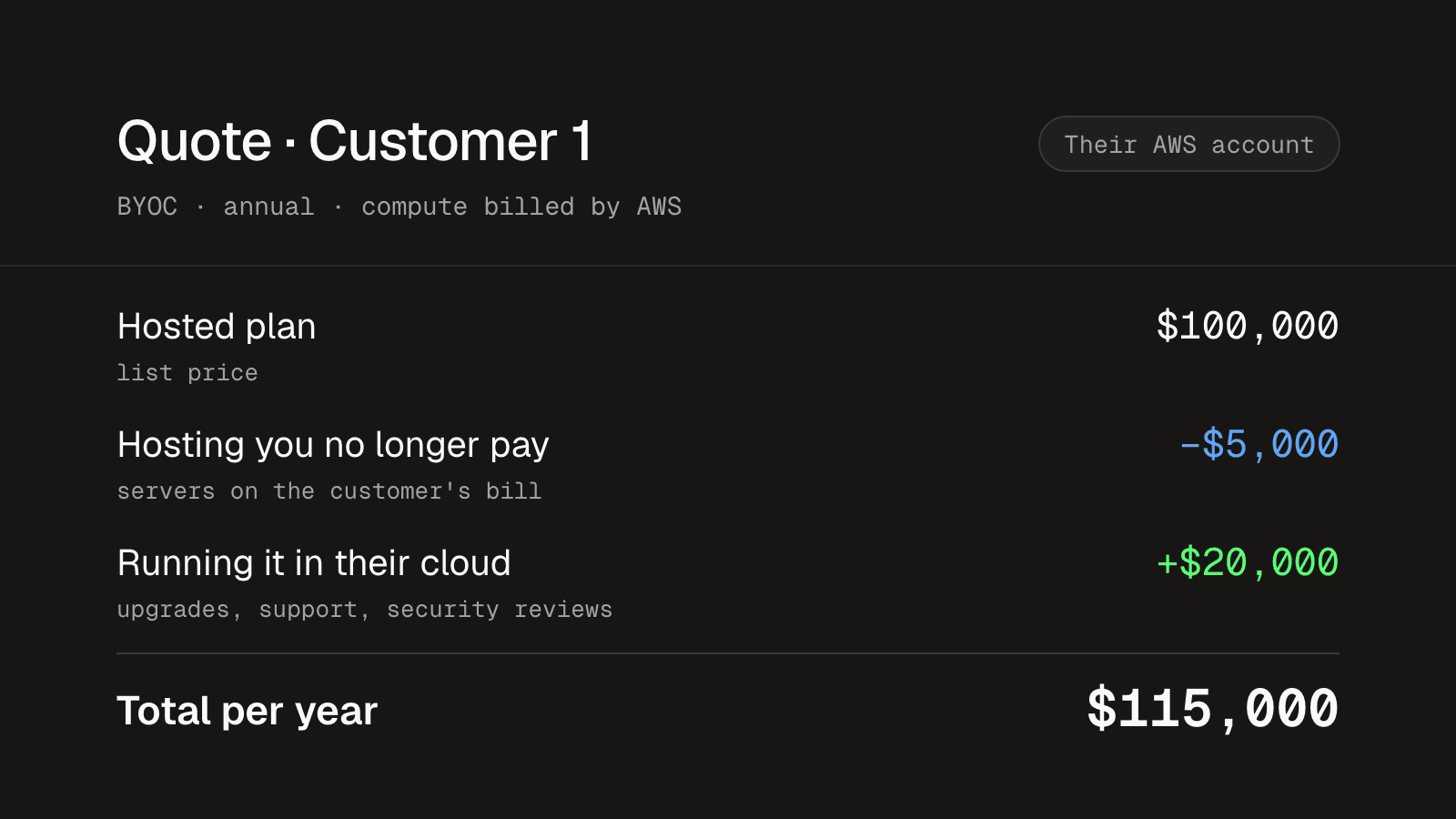
You offer BYOC to an enterprise customer. Your software will run in their AWS account, on their compute, on their bill.
The first thing their procurement team says:
"We're paying for the compute now. So we want a discount."
Sounds fair. Most founders say yes.
For most software... that's the wrong answer. BYOC should usually cost more than your hosted product, not less. It comes down to what your price was paying for in the first place.
What was your price paying for?
In SaaS, you pay for the servers and your price includes them. In BYOC, the servers move to the customer's AWS, Google Cloud or Azure bill. Your invoice covers the software, the updates, the monitoring and the support.
So the only real question is how much of your hosted price was servers.
A database (StarTree)
Typical B2B software
If you sell a database or a data pipeline, the answer is "most of it". StarTree charges $0.21 per vCPU-hour hosted and $0.11 in BYOC. Hydrolix and Aiven are about 35% cheaper. When the customer pays for the compute, the price should drop a lot. It does.
If you sell software, the answer is "almost none". GitLab charges the same $29 per user hosted or self-managed. Metabase charges the same Pro price. GitHub and Retool only sell self-hosting on Enterprise, and n8n starts it at its €667/month Business plan.
I looked for an application vendor that prices self-hosting below hosted. I couldn't find one.
How much to take off
Take off what you no longer pay. Nothing more.
For most B2B software, that's small. The median private SaaS company spends 5% of ARR on hosting. So the fair discount is about 5%.
AI products are in between, because models and GPUs can be a big part of every dollar. One founder selling AI security told me that when they host, they charge about 5x what the cloud and models cost them. In the customer's cloud, on the customer's own model accounts, almost all of it is margin.
So if your customer takes on a big AI bill, some discount is fair. Same rule: take off what you no longer pay.
Then add what it costs you
This is the part buyers don't see. BYOC costs you more to run.
Every deployment is an environment you're responsible for... but can't log into. You go through their security review. You wait for their change windows. You support versions they haven't upgraded yet.
When a founder asked me how to price BYOC, this is what I told them:
Since you're responsible for managing the software in the customer's cloud, you can add a 10–30% BYOC premium for extra deployment, support, security reviews, upgrades, and customer-specific ops.
For typical software, that's 5% off and 10 to 30% on. BYOC ends up 5 to 25% above your hosted price.
"But our ARR will look smaller"
Founders worry about this one more than the discount.
When you host, the compute is inside your price. Every dollar the customer pays for servers, GPUs or tokens counts as ARR. In BYOC that money goes straight to AWS, and the headline number shrinks.
For a VC-backed startup, that hurts. ARR is the number that gets you the next round.
But investors are starting to look under it. Here's investor Nikunj Kothari:
The bigger funds say the same thing, more politely. a16z's Jennifer Li: "Not all ARR is created equal, and not all growth is equal either." Bessemer found the fastest-growing AI startups run at about 25% gross margin, against about 60% for the steadier ones. Jason Lemkin: "A 35% gross margin is infrastructure or a services business. A 70% gross margin is starting to look like… software."
Some companies already moved. Tomasz Tunguz: "Some AI companies already use gross profit as a quota metric rather than revenue."
Now take two made-up companies:
- Hosted: $10M ARR. $6M of it goes to AWS and model providers. Gross profit: $4M.
- BYOC: $5M ARR. The customer pays AWS directly. At an 85% gross margin, gross profit is $4.25M.
Half the ARR... and more gross profit. Every BYOC dollar is software.
There's a public version of this. Databricks runs on the customer's own cloud account, Snowflake bundles the compute. Tunguz puts Databricks' gross margin about 15% higher, primarily because customers operate their own compute.
a16z argues that low AI margins today don't mean low margins forever. Maybe. BYOC doesn't need that bet. The margin is there from the first deal.
To be fair, most rounds are still priced on revenue multiples. So don't hide the ARR. Show ARR and gross profit side by side, and let the margin make the case.
Charge for value, not for their servers
Usage pricing still works in BYOC. Bigger deployments still mean more work for you.
But pick a unit that tracks value, not the customer's infrastructure. If you charge per node, the way you make more money is adding nodes to their cluster. Jack Vanlightly wrote exactly that about BYOC vendors that charge per node.
groundcover charges per host, not per GB, because per-GB pricing "creates a structural incentive to send less data". WarpStream charges for uncompressed data written, so it's "encouraged to reduce your cloud infrastructure costs".
If your revenue today is a markup on compute, BYOC will look like smaller deals. A founder who sells hosted compute told me exactly that. It's a sign to change what you charge for... not to skip BYOC.
The deals get bigger
At my previous startup, deals were around $50K a year. Then we added one option: install it in the customer's cloud. Same product, same team. Deals went to $300K over three years.
People ask whether the same customer would have paid $300K for the same usage. Wrong comparison. Those customers wouldn't have bought at all without BYOC.
BYOC doesn't make a deal bigger by itself. The bigger the company, the stricter its security team. And those are the ones that require it.
Let them pay with money they already committed
Big companies sign multi-year spending commitments with AWS, Google Cloud and Azure. In BYOC, your compute counts against that commitment. Redis says it directly: customers "fully utilize existing commitments."
Sell through the cloud marketplace and your fee can count too. On Azure, 100% of eligible marketplace purchases count. On Google Cloud, marketplace spend may count in full, with some exclusions. On AWS it depends on each customer's agreement, so ask their AWS team.
Don't expect a marketplace listing to bring you leads. We learned that the hard way. But it helps you close: the customer pays with money they already committed, without a new procurement process.
The model
- Start from your hosted price.
- Take off the hosting you no longer pay.
- Add 10–30% for running it in their account.
- Meter something the customer counts as value, never their own infrastructure.
- Sell it as an annual commitment, and offer a marketplace private offer (a custom price sold through the cloud marketplace) to customers with a cloud commitment.
Then make sure each new deployment costs you almost nothing to operate. Pydantic, after a year of offering self-hosting: "the build is not the hard part. The ongoing support surface is." If every deployment needs an engineer on a Zoom call, support eats the margin.
That's what Alien does: one release to every customer's cloud, with health and logs from each deployment, without access to their account. Alien's own pricing is per deployment.
What BYOC is and how it differs from self-hosting is in what is BYOC. How other teams ship into their customers' clouds is in customer stories.